

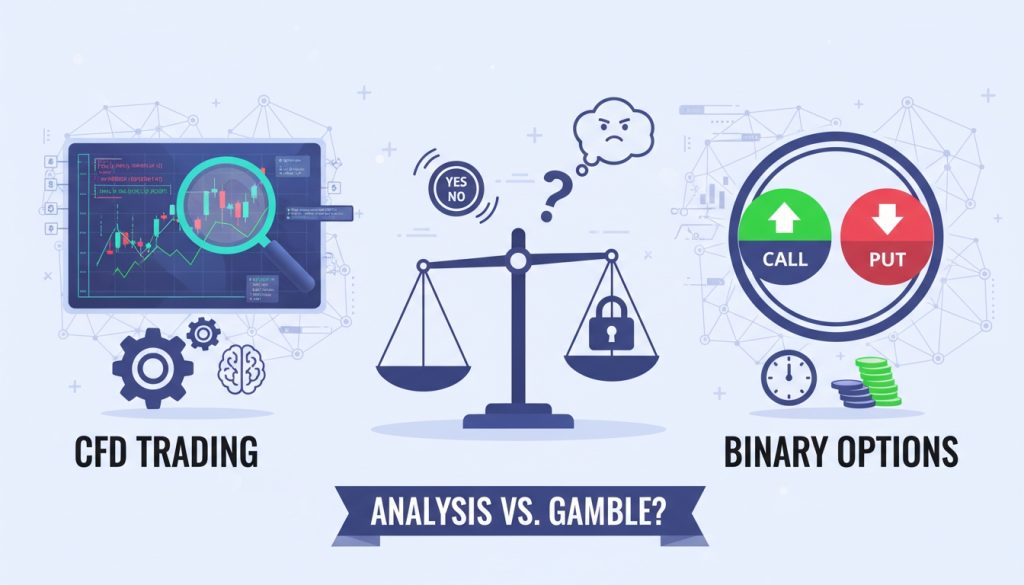
If you boil both products down to one line, the difference is blunt.
A CFD is a contract with your broker where you pay or receive the price difference between when you open and when you close a position.
A binary option is a fixed bet on whether something is true at a specific time. If you’re right, you get a preset payout. If you’re wrong, you lose your entire stake.
On a platform screen that difference is easy to miss. A CFD ticket and a binary ticket might both show the same EURUSD chart, the same time frame and the same price. A trader clicks buy or sell and watches a profit or loss figure. Underneath that similar surface the contracts push your account in very different directions.
CFDs have a linear payoff. Every extra point in your favour adds the same amount to profit, every extra point against you adds the same amount to loss, until you close. Binary options pay a fixed amount or nothing. Being very right or just barely right at expiry does not change the payout.
Once you see those two shapes clearly, the case for using CFDs over binaries for almost any serious trading goal gets much stronger. One gives you levers to manage risk, scale, and timing. The other compresses everything into a yes-or-no outcome that carries a built-in edge for the house.
How a CFD really works in a trading account
A contract for difference mirrors the movement of an underlying asset without you owning that asset. You and your broker agree that when you open a position a reference price is set. When you close that position the difference between the two prices is settled in cash to your account.
Take a simple long on an index CFD. You buy one contract with a value of one unit of currency per point. The index stands at 4,000. If it rises to 4,050 and you close there, you gain 50 units before costs. If it drops to 3,950 and you cut the trade, you lose 50 units. You can close anywhere between those levels or beyond, because there is no fixed expiry dictated by the product. The contract just tracks ticks.
Margin is the other core part. You do not need to post the full notional value. The broker sets a margin rate, perhaps five percent or ten percent for a major index. That amount is set aside as collateral while the position is open. Gains and losses are marked on your equity in real time. If equity falls too near the margin requirement, a stop-out rule kicks in and positions are reduced or closed to keep the account solvent.
You also pay to hold positions. Part of that cost is the spread between bid and ask. There may be a separate commission. If you hold overnight, financing charges or credits apply depending on direction and the relative interest rates involved in the underlying. All of this is at least visible and can be planned for if you read the contract specs.
The key thing is that a CFD acts like a scaled version of holding or shorting the asset. It lets you trade direction, hedge, or run short term strategies with more flexibility than spot holdings, but it does not change the basic rule that your P&L is tied point-for-point to price movements until you decide to close.
What you actually buy when you trade a binary option
A binary option strips away that smooth link between price path and outcome. You pick a market, a direction, and a timeframe. The contract pays a fixed amount if the market meets the condition at expiry, and pays zero if not.
Say you take a one hour binary call on GBPUSD with a strike at 1.2600. You risk 100 units and the platform offers a payout of 180 if the pair ends above the strike at the exact expiry time. For that whole hour the chart might move up and down. You might see unrealised profit if you watch a live quote feed. None of that has any effect unless the final reference price is above or below 1.2600 when the clock hits.
Under the hood this is a digital option. In institutional desks, digitals exist as tools in structured payoffs. In the retail setting, the way they are packaged and sold makes them closer to fixed-odds bets. The broker chooses the payout ratio, the strike levels and the expiry grid in a way that builds in a margin in favour of the house.
Most retail binaries also bundle money management decisions into the contract design. Stake is all-or-nothing on each trade. You cannot nudge size mid-trade. You usually cannot rescue part of a losing bet by moving a stop, and early sale features that exist often come with steep pricing hidden in the quote.
That simplicity feels neat on the surface. You see a clear potential gain, a clear maximum loss and a countdown. The price for that neatness is that you lose almost all control once the trade is live, and the odds encoded in the payout often do not match the real probability of the event in a way that favours the trader.
You can learn more about how binary options really work by visiting BinaryOptions.net. A website completely devoted to binary options and binary options trading.
Payoff shape and risk: straight line vs cliff edge
If you draw both products on a graph with profit and loss on the vertical axis and underlying price on the horizontal axis, a CFD payoff is a straight diagonal line. A binary payoff looks like a step or cliff.
For a CFD long, every tick above your entry adds a little profit. Every tick below subtracts a little. If price moves a lot in your favour the line continues upwards. If it moves against you, the line slopes down. You decide where on that line you want to exit. The line is continuous. There is no single price where everything suddenly flips.
A binary payoff sits flat at zero until the strike is reached at expiry and then jumps to a fixed amount if the condition is met. It does not matter whether the market is one point above the strike or one hundred points above, if your contract pays a fixed sum it will be the same in both cases. There is a hidden cliff there. Small changes around the strike at expiry are the difference between full loss and full payout.
This has practical consequences for risk. With CFDs you can shape your risk distribution. If you cut losers at a certain distance and let some winners run further, your individual trade results can form a pattern where average wins exceed average losses even if your hit rate is not very high. The product allows for that pattern because profit per trade is not capped by a fixed payout.
With binaries, loss per trade is always the stake. Win per trade is bounded by the advertised payout. The hit rate you need to avoid bleeding the account is fixed by that ratio. If you risk one to make 0.8 on each correct call, you need to be right well above half the time just to tread water. There is no way to offset that with longer winners, because a win never pays more than the fixed figure.
There is also time risk. CFD trades can be closed early if the setup breaks down. You are not forced to hold through a news event if you decide the odds are poor. Binary trades depend on a single snapshot. A small spike in the last second can change the whole outcome. That creates a very twitchy exposure profile, which can be uncomfortable when size grows.
None of this makes CFDs safe by default. High gearing can still wipe you out. But at least the payoff structure gives you room to shape risk and reward. Binary structures compress both into a hard yes or no, which is much harder to bend in your favour over a long run of trades.
Cost structure and expected value: commissions vs house edge
Both products take money from you through their cost structures. The difference is in how visible and adjustable those costs are, and in how heavily they lean the long-run expectation against the client.
CFDs collect from three main sources. There is the spread between bid and ask, which you pay when entering and exiting. There may be a direct commission per trade or per contract. And there are overnight financing charges on positions held beyond the trading day, often expressed as a swap or daily rate.
Most of these are at least somewhat in your control. You can favour instruments with tighter spreads, trade at times of better liquidity to avoid wide markets, choose brokers with clear commission schedules, and adjust your holding period so that financing does not eat into trades that are supposed to be short term.
If your method has a genuine edge, meaning your trade selection has positive expected value before costs, you can design around those frictions. They will always drag returns down, but they do not completely swamp the signal if it is strong enough.
Binary options wrap their margin in the odds themselves. The platform sets the payout rates. Instead of charging a separate commission, the broker simply pays less on winning bets than true risk-neutral prices would suggest. If the chance of finishing in the money is near fifty percent and the payout on a correct call is below double the stake, then by straight arithmetic the expected value of repeated bets is negative.
This is not just theory. If a contract has a 55 percent true chance of ending in the money but the platform offers a payout that assumes it has a 60 or 65 percent chance, the extra difference becomes revenue for the house over time. Traders might still have short runs of good luck, but the design expects the average user to lose.
With CFDs, the broker makes money whether a particular client wins or loses, as long as volume is there and risk is hedged smartly. The business model can coexist with a client who is net profitable. With binaries, the model depends heavily on the gap between fair odds and offered odds. If you somehow manage to beat that gap, you are directly pushing against the platform’s revenue stream.
From a trader’s point of view, that shift matters. In one case, you are fighting market noise, your own psychology and a manageable layer of spreads and fees. In the other case you are doing all that plus trying to beat a hard coded negative expectation baked into every trade.
Trade management and timing: exits, hedging and error correction
Real trading rarely follows the clean line on a textbook diagram. Entries are a bit early or late, news hits halfway through, correlations change for a day, and you realise you have misread the context. Product design decides how much room you have to adapt.
CFDs give you continuous control over timing. You can enter with partial size, add if price confirms your view, or cut size if price action contradicts it. You can move stops to reflect new information. If a trade reaches a level you pre-marked as an inflection area, you can bank part of the profit and keep a remainder with a tightened stop. You can close everything before a major announcement and reopen after if you do not like gap risk.
On top of that, CFDs play better with hedging. A trader long a stock portfolio might short an index CFD to reduce net equity exposure during a period of uncertainty. An FX trader might open a small opposite position in a related pair to smooth overall risk while a key level plays out. These are not perfect hedges, but they come from the same price paths and can be monitored and adjusted tick by tick.
Binary options are rigid once opened. If you take a 30 minute “above” position on a currency pair and ten minutes in you realise your read of order flow was wrong, you usually have two choices. You sit and accept the full loss if the market finishes against you, or you try to sell the option back early, often at a disadvantageous price that reflects both current probability and the platform’s margin.
There is no scaling in or out within the same ticket. Hedging with another binary just creates another fixed payoff that might or might not line up. You can hedge direction by taking an opposite binary, but that mostly just locks in a known loss of combined stake unless odds have moved strongly in your favour.
For traders who care about process rather than one-off punts, that lack of control is a serious problem. Risk management is not only about how much you risk per trade at entry. It is also about how you respond to changing conditions. CFDs at least give you tools to do that. Binaries trap you in the original bet far more tightly.
Broker models, regulation and protection for clients
The structure of the broker or platform that offers a product shapes the risk beyond pure market moves. That includes how client money is held, how disputes are handled, and what standards apply to marketing and trade execution.
CFD providers in most major regions operate under financial regulation frameworks that treat CFDs as derivatives. Those frameworks usually cover capital adequacy, segregation of client funds from firm funds, reporting, audits and conduct rules around how products are promoted. Oversight quality varies by jurisdiction, and there are weak spots, but there is at least a formal system.
Many CFD brokers hedge client positions in the wholesale market using futures, swaps or direct market access. Others internalise flow but still manage risk through net exposure and external hedges. In either case, larger firms are normally integrated into wider financial plumbing, with banks, clearing firms and external auditors watching parts of the chain.
Binary option outlets, especially the ones that target retail traders with aggressive advertising, have not enjoyed the same standing. They have often based themselves in places with light oversight, run very hard sales tactics, and handled client complaints poorly. Several regions have treated retail binary options as something closer to wagering and have clamped down, either banning retail sale or placing strong restrictions on it.
From a client angle, this shows up in dispute resolution. If you argue over a fill, a platform outage or a withdrawal delay at a regulated CFD firm, there is usually an internal complaints route and then, if that fails, some form of external ombudsman or regulator. You may still not get the answer you want, but the process exists.
With offshore binary sites the process often ends with a few polite emails and no practical way to escalate. Even where a licence exists, it might be under a very weak authority which offers little real protection.
None of this makes CFD brokers saints. You still need to look at who supervises them, how solid the firm is, and how they handle risk. But if you compare the average CFD provider under mainstream regulation to an unregulated binary shop, the former gives you a much better starting point if you care about keeping your account alive for years rather than months.
Which product fits which job and why CFD usually wins
Think about the jobs a retail trader or small investor might want to get done in markets. Short term speculation on direction. Portfolio hedging. Gradual growth of capital through compounding. Occasional high-conviction trades with defined risk. Each of those needs a certain kind of tool.
CFDs suit directional trading across many time scales. You can day trade indices or FX pairs, swing trade individual stocks, or sit in positions for weeks if financing works for your plan. You can define risk with stops relative to actual chart structure, not a clock on the wall. You can adjust size to reflect conviction, volatility, and correlation with the rest of your book.
For hedging they are one of the few products that map neatly onto retail portfolios. A CFD short on an index can offset beta in a stock basket. A CFD short on a currency pair can roughly balance exposure from overseas holdings. Again, not perfect, but the link between hedge and underlying risk is at least continuous and easy to monitor.
Binaries struggle to fit any of those roles. They are too blunt for hedging and too rigid for careful trading plans. Where they do fit is in pure speculation with hard capped stake sizes. If someone wants to risk a small fixed sum on whether a market will be above or below a level at a certain time and sees that as entertainment, binaries can provide that in a very simple format.
The issue comes when binaries are presented as a regular trading alternative. The structure fights the aims of risk control and compounding. Every wrong call burns the full stake. Every right call pays the same fixed amount regardless of how strong the move was. That keeps equity curves jagged and makes it very tough to build consistency.
CFDs are not magic. They can amplify losses as easily as gains if geared too high or managed carelessly. But they at least give a trader the mechanical capacity to align product behaviour with a strategy. Stops, adds, partial exits, hedges and sizing rules all actually work with them.
Final thoughts: use CFDs as tools, treat binaries as bets
For traders and investors who already understand the basics of price action and risk, the choice between CFDs and binary options should not hinge on marketing slogans. It should hinge on whether the product lets you run a method with some hope of positive expectancy and sensible risk control.
CFDs, used with respect for margin and position size, behave like flexible mirrors of the underlying market. They have costs and they carry serious risk, but those risks can be shaped, monitored and adjusted in real time. They can fit into trading plans, hedging plans and longer term capital plans.
Binary options, in the form most retail platforms offer, function more like structured bets with a house edge. They compress risk into all-or-nothing outcomes on short time frames. They leave very little room to correct mistakes or use partial exits. Their payoff ratios are often set so that the mathematically expected result over many trades is a loss.
Because of that, CFDs are a better option than binary options for almost any goal other than pure entertainment with money you can truly afford to lose. Treat CFDs as tools that can support a trading business if handled with care. Treat binary options, if you use them at all, as tiny side bets that do not belong at the centre of your plan.