

Understanding the Importance of a Trading Journal
Keeping a trading journal is a fundamental practice for both novice and experienced traders. It serves as a record of trades and strategies, helping traders learn from past experiences and improve future performance. By maintaining a detailed journal, you can objectively evaluate your trading activities and make informed decisions.
Why a Trading Journal Matters
A trading journal is not merely a note-taking tool; it is a pivotal element in the toolkit of a serious trader. It substantiates the transition from arbitrary trading approaches to structured and disciplined practices. For new traders, it provides a foundation upon which to build their skills and understanding of the markets. For the experienced, it is an indispensable tool for ongoing refinement and mastery.
Consider the challenges in the trading world that stem from rapidly changing markets, emotional biases, and repeated mistakes. The absence of a system to track and analyze these elements means missed learning opportunities and can lead to recurrent errors. Therefore, it becomes essential to deploy a trading journal as an avenue for critical reflection and evaluation.
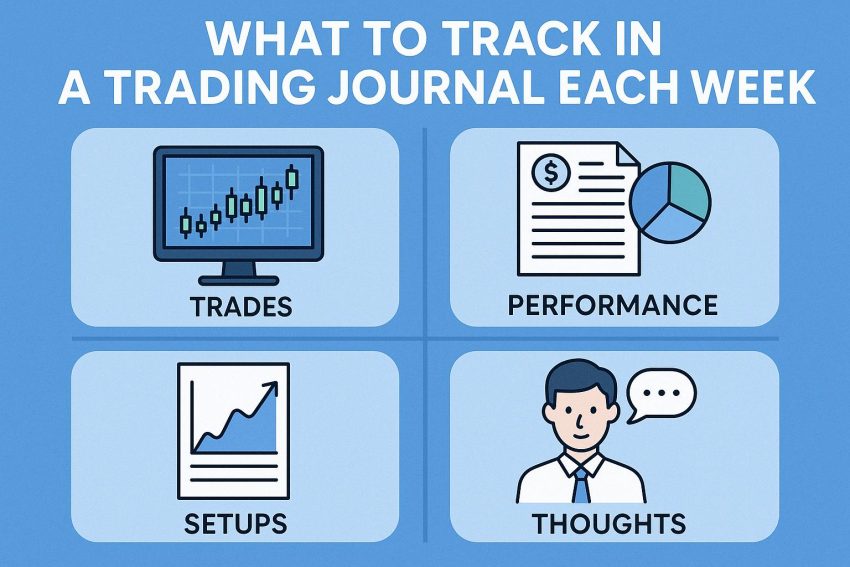
Key Elements to Track in a Trading Journal Each Week
1. Trade Details
Document the specifics of each trade you execute. This includes the date and time of the trade, the instrument traded, and the position size. Capturing these details allows for a comprehensive overview of your trading activities over time. By annotating such information, traders equip themselves with an informative log that abstracts trading frequency patterns and position sizing tendencies, optimizing future trade considerations.
2. Entry and Exit Points
Record the entry and exit points for each trade. This data not only helps in calculating profit and loss but also assists in identifying patterns and refining entry and exit strategies. Aim to specify the technical or fundamental factors influencing these decisions. By analyzing entry and exit points in different market conditions, insights can be gained into areas of improvement or reiteration for consistently successful trading tactics.
3. Market Conditions
Every trade exists within a specific market context. Keep track of the prevailing market conditions, such as volatility levels, economic news impacting the markets, and overall trend direction. Understanding the broader environment provides insights into how external factors affect your trading outcomes. Mapping market conditions against your trading decisions further complements the learning curve by placing subjective decisions under the scrutiny of objective parameters.
4. Trade Rationale
It’s crucial to note the rationale behind each trade. Was it based on technical analysis, a news event, or a strategic plan? Documenting your reasoning helps you understand your decision-making process and refine your trading strategy. Over time, the accumulated trade rationales form a compendium of insight, driving the evolution of an intuitive yet analytics-backed trading instinct.
5. Risk and Reward Metrics
Include details about the risk-reward ratio anticipated in the trade. Record the stop-loss and take-profit levels you set, and assess whether the actual risk and reward met your expectations. This evaluation aids in managing risk more effectively in future trades. A meticulous analysis of risk-reward metrics uncovers the nuances between conservative and aggressive trading behaviors, paving the way for more grounded decision-making in uncertain settings.
6. Emotional State
Emotions play a significant role in trading. Record your emotional state before, during, and after each trade. Identifying patterns in your emotional responses can help you recognize biases or tendencies that might impact trading decisions. The advent of behavior recognition through emotional journaling thus evolves a trader from weathering impulsive, emotionally charged decisions to displaying calm, calculated reasoning under pressure.
7. Performance Review
At the end of each week, include a performance review. Summarize what went well, what didn’t, and any lessons learned. Consider how your strategy might be adapted based on the insights gained. This reflection is key to continuous improvement. Merely trading is not enough; traders grow through the synthesis and analysis of successes and mistakes alike, constantly refining their approach for heightened effectiveness in the future.
The Role of Consistent Tracking
Consistency is a hallmark of successful trading journals. By frequently updating your journal, the evolving patterns become evident, enabling you to build upon successful strategies and eliminate unproductive habits. Traders leaping from sporadic documentation to consistent journaling often experience improved clarity and focus in their trading endeavors.
Conclusion
By systematically tracking these elements in a trading journal, traders can cultivate a disciplined trading approach and gain valuable insights into their trading practices. Regular journaling not only aids in performance assessment but also contributes to personal growth as a trader. Traders gradually develop a nuanced understanding of market mechanics, empowering themselves to navigate even the most challenging markets with resilience and adeptness.
Continuously refine your trading strategies and expand your understanding by delving into extensive resources. For further reading on enhancing trading strategies, consider exploring articles from reputable financial analysis platforms such as Investopedia or Bloomberg.